
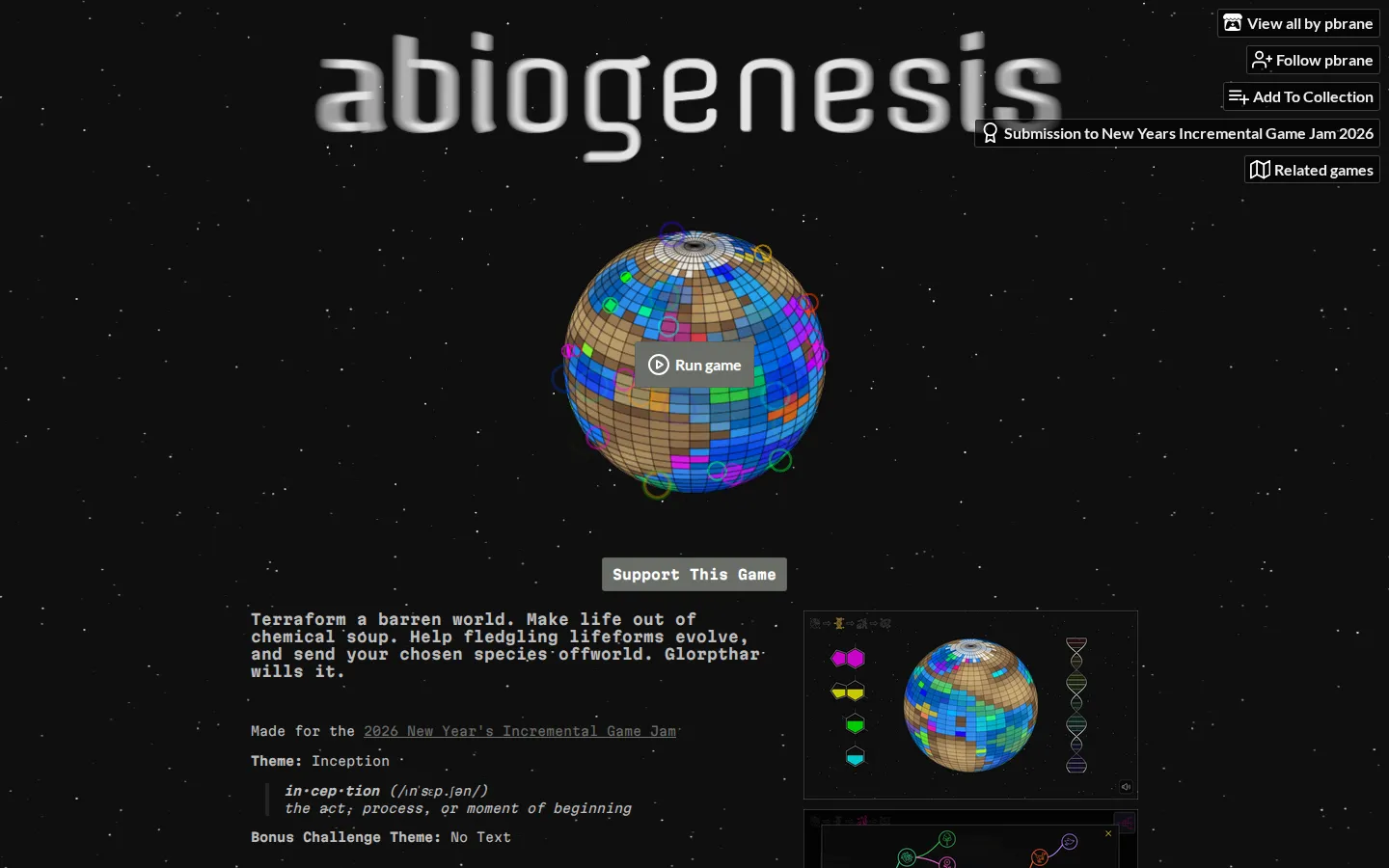
Abiogenesis compresses planetary history into a short, mostly icon-driven incremental game. You terraform a world, coax life from chemical beginnings, steer species through several changing phases, and eventually aim beyond the planet. Its no-text design is clever but can also leave resources and upgrades mysterious.
What is Abiogenesis?
The opening promise is gloriously oversized: begin with a dead planet and finish with a species headed offworld. Abiogenesis chops that arc into a sequence of incremental systems, changing the job as chemistry gives way to life, DNA, ecosystems, and a wider cosmic ambition. The interface was built for a game-jam challenge that discouraged text, so much of the pleasure comes from watching symbols, testing a button, and noticing what the planet does next. That constraint creates some lovely aha moments, but it also produces real fog. Independent players repeatedly reported heavy clicking and uncertainty about currencies, upgrades, or later-stage goals. Even with those rough edges, the concept landed: the game took first overall in its jam and ranked near the top for theme and originality. It feels less like a biology lesson than a compact toy history of life, with a very small control panel attached to a very large timescale.
What you can do there
- Terraform a barren planet
- Develop life from a chemical starting point
- Guide species through evolution and offworld expansion
Why we picked it
Few incremental games change the scale of their subject this boldly. One minute the problem is a blank planet; later, a species is trying to leave it. The no-text constraint turns evolution into a visual decoding exercise, and the parade of distinct phases keeps the usual numbers-go-up loop from sitting still for long.
How to get the most from it
Choose Run game on a desktop and give the first phase a few experimental clicks before trying to optimize it. Watch for color, icon, and planet-state changes rather than waiting for written instructions. If a later phase feels opaque, slow down and test one control at a time; the interface can hide what a resource or upgrade is doing.
Good to know
The released HTML5 game is free to run with an optional support link, and its page estimates about a half-hour per session. Music, narration, and voices are credited, but they were not played during this review. Expect repeated clicking and an intentionally sparse interface; independent players praised its creativity while also flagging unclear information in later phases. Save/restore behavior, mobile support, accessibility, scientific accuracy, and privacy behavior were not tested.
Who made it, and when?
pbrane is the credited creator or organization.
Creator’s official page Open AbiogenesisMore like this
Neal.fun

A cabinet of interactive ideas that makes learning feel suspiciously like play.
Quick, Draw!

Doodle against the clock while a neural network tries to guess your subject.
Sandspiel

Paint with sand, water, fire, plants, oil, and other tiny materials that react to one another.
WebGL Fluid Simulation

Push luminous liquid color around the screen and watch digital turbulence behave beautifully.