
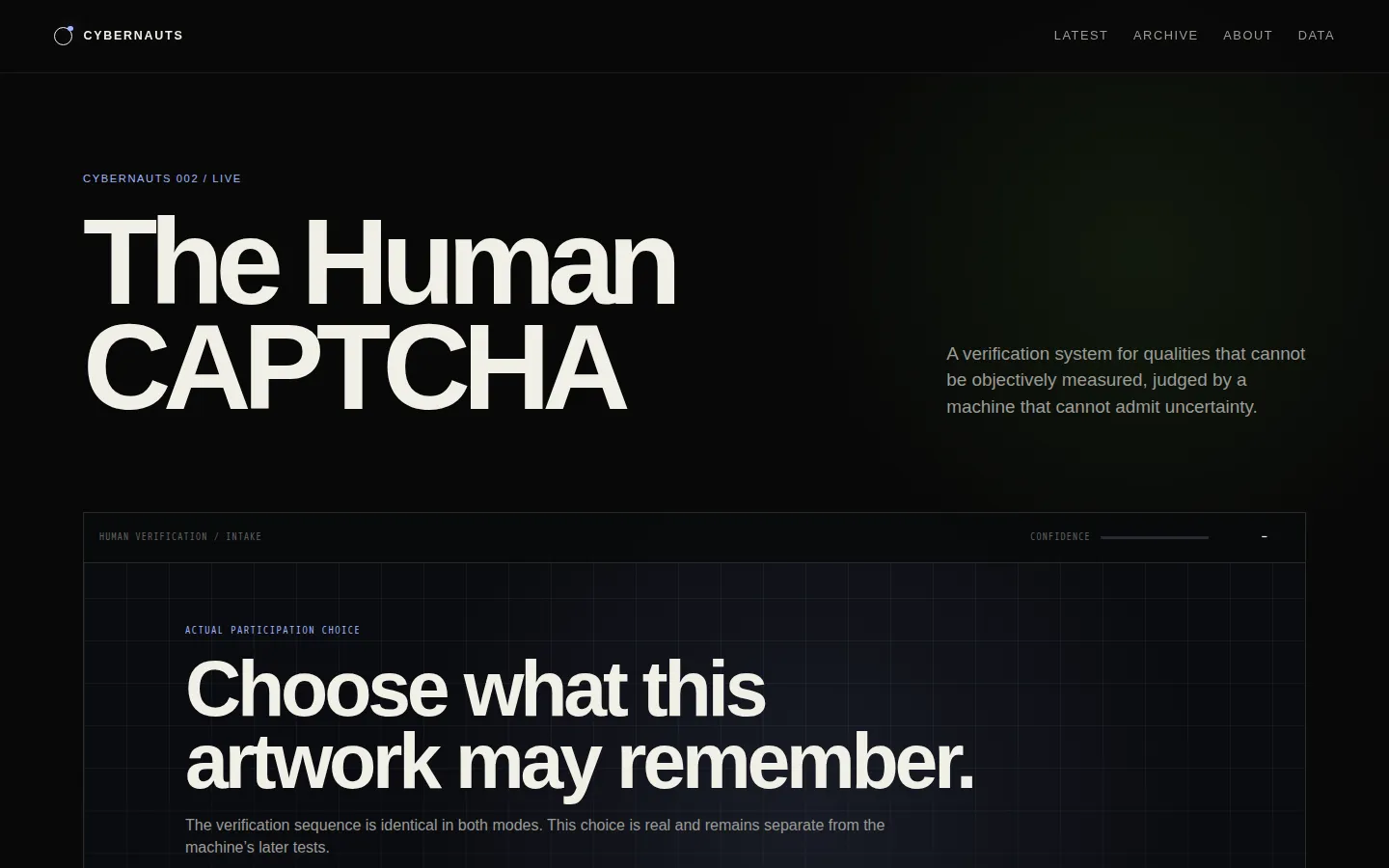
The Human CAPTCHA stretches familiar bot checks into six subjective trials of recognition, rhythm, care, memory, spontaneity, and prediction. Every answer feeds a confidence meter, but the real test is whether you resemble the narrow person its rules expect.
What is The Human CAPTCHA?
First, choose whether the encounter stays private or contributes one anonymous summary to the collective totals. Then the page rotates through six kinds of proof, swapping traffic lights and squiggly letters for timing, drawing, recollection, motion, and judgment calls. A final prediction is committed before you see its choice, yet either matching or defying it can be folded back into the verdict. That no-win logic is the work's sharpest joke: a system can design the category, set the threshold, grade the evidence, and still present its answer as neutral.
What you can do there
- Choose private or anonymous collective participation
- Complete six subjective verification tests
- Inspect and share the system's final determination
Why we picked it
This piece turns CAPTCHA annoyance into a compact lesson about automated authority. The tests are varied enough to feel playful, while the final reveal shows how quickly a model's preferences can masquerade as a universal definition. The private route keeps the critique from demanding the very data surrender it questions.
How to get the most from it
Pick Private Encounter if you want the full sequence without adding a result to the aggregate. Respond naturally rather than hunting for a perfect answer, and watch how the confidence language changes as the tests move from recognition toward prediction. Use Exit / reveal if you want to skip ahead to the premise.
Good to know
Allow about five to eight minutes. Both modes contain the same six tests; Collective Encounter submits a compact anonymous summary, while raw drawings, tap timing, and orientation streams are documented as staying local. Optional motion has a fallback, but ordinary hosting logs may exist and final retention details are not yet posted.
Who made it, and when?
James Malzahn is the credited creator or organization.
Creator’s official page Open The Human CAPTCHAMore like this
Zoomquilt
An endlessly falling illustrated world nested inside itself.
Thisissand

Pour tiny grains of color into layered landscapes, patterns, and patient accidents.
Click Click Click

A green button that turns browser habits into a tiny surveillance drama.
Beige balls

Twelve colorful-looking spheres, one beige reality, and a tidy lesson in how nearby stripes boss your eyes around.